Crypto Alongside Your Investments
Track Bitcoin, Ethereum, and other cryptocurrencies in the same transaction ledger as your stocks, ETFs, options, and bonds — with USD-denominated quotes and crypto-aware tax handling.
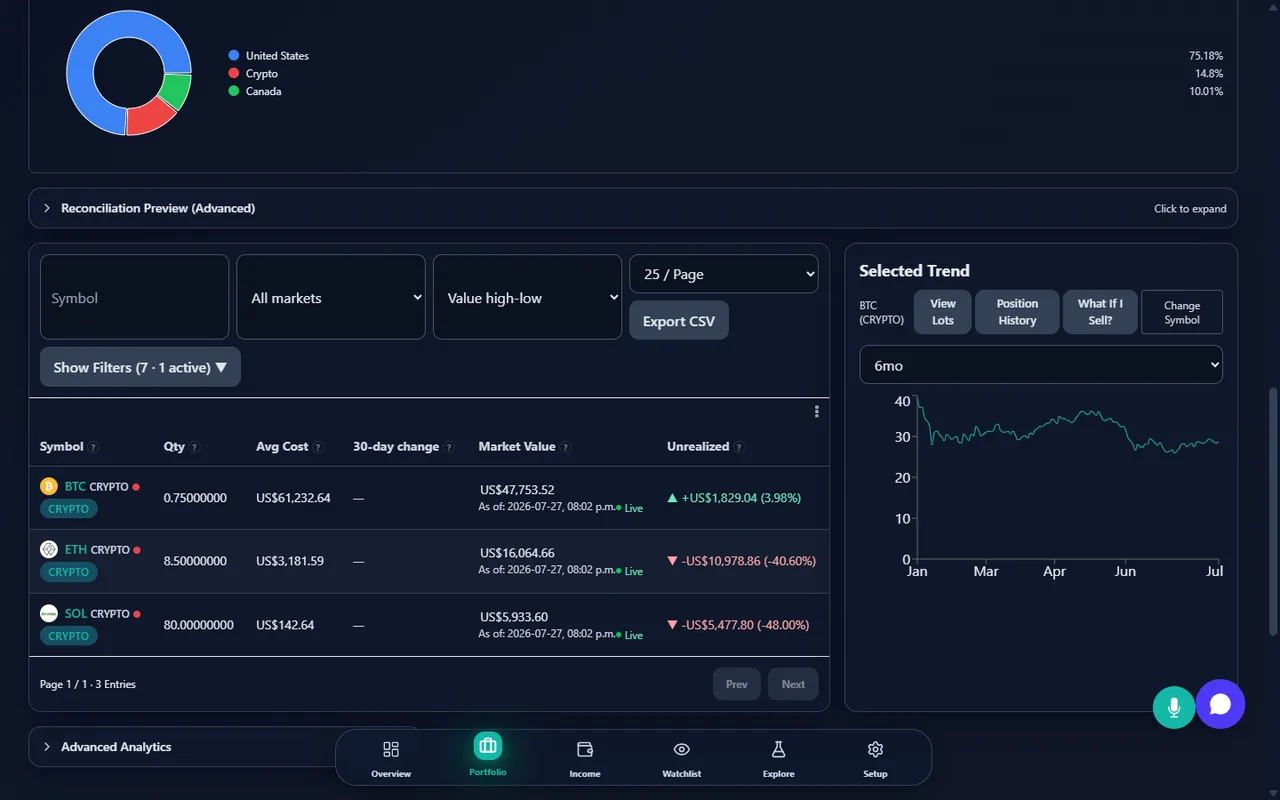
Priced From the Same Feed as Your Stocks
Major coins (Bitcoin, Ethereum, Solana), DeFi tokens, Layer 1 and Layer 2 networks and stablecoins are quoted through the same market data provider your stocks and ETFs use. A crypto symbol is requested as its US dollar pair, so coverage is whatever that provider lists rather than a fixed roster maintained here.
USD-Denominated Quotes
Last price, 24-hour percentage change, market capitalization, and trading volume are pulled for each holding. Quotes are USD-denominated and automatically converted to your base currency. They are served from a short-lived cache and may be delayed — this is not a live tick feed.
Historical Price Charts
View historical daily price data for any supported cryptocurrency across ranges from 1 day to 5 years, so you can see how a holding's price has moved over time.
One Ledger for Every Asset Class
Crypto transactions live in the same buy/sell ledger as your stocks, ETFs, options, and bonds — holdings, cost basis, and P&L are computed the same way across every asset you own.
24/7 Market Status
Unlike stock exchanges, crypto markets never close. Your crypto holdings always show as actively trading, with no market-hours restriction on price updates.
Crypto-Specific Tax Treatment
Dispositions, crypto-to-crypto swaps, staking and mining income, and airdrops are each classified with the applicable tax treatment. Canadian taxpayers additionally get the CRA superficial-loss rule (30-day window) applied specifically to crypto positions.
How it works
Record buys and sells like any other holding
A crypto purchase is a transaction on the same ledger as a stock purchase: date, quantity, price, fees, currency. Holdings, cost basis and profit and loss are derived the same way, so crypto appears in your allocation and net worth without a second app.
Prices come from the same provider as your stocks
A crypto holding is requested from the same market data provider as your equities, as its US dollar pair, which supplies last price, twenty-four hour change, market capitalisation and volume. Quotes arrive in US dollars, are cached for several minutes, and are converted into your base currency for display.
Markets that never close are treated as such
Crypto is not subject to exchange hours, so positions are treated as continuously trading. A value shown on a Sunday evening is current rather than a stale Friday close carried over the weekend.
Dispositions are classified for tax
Sales, crypto-to-crypto swaps, staking and mining income, and airdrops each carry their own tax treatment. For Canadian holders, the thirty-day superficial loss rule is applied to crypto positions specifically rather than borrowed from the equity path.
What it does not do
Knowing where a tool stops is worth more than a longer list of what it claims. These are the boundaries of what StockWatcher does here.
No wallet or exchange connection
There is no wallet address to paste, no exchange API key to enter, and no on-chain scanning. Transactions arrive the way every other transaction does: entered by you or imported from a file.
Coverage is limited to what the provider quotes
Pricing works only for coins the market data provider quotes against the US dollar. A newly launched token, a small-capitalisation asset, or a coin that trades on a single venue may not be priced at all, and an unpriced holding cannot be valued. No count of supported coins is published here because that list is the provider's, not ours.
No DeFi, liquidity pool, or NFT accounting
Liquidity positions, lending protocols, yield farming, gas fees as cost basis, and non-fungible tokens are not modelled. Staking rewards can be recorded and classified, but the protocol activity that produced them is not tracked.
Crypto tax rules are unsettled and vary by country
Classification follows general US and Canadian guidance for common events. Rules differ elsewhere, change frequently, and can turn on details of your situation this tool has no view of. Treat the output as reference data for a tax professional.
Related Resources
Start tracking your crypto alongside your portfolio
Crypto holdings are tracked on every plan, including Free. The crypto tax classification tools are available on the Pro plan. Free 14-day Pro trial included.
Create Your Free AccountCryptocurrency prices are highly volatile and are supplied by the same third-party market data provider used for equities; quotes are cached, may be delayed, and may be temporarily unavailable. Tax classifications (dispositions, staking, mining, airdrops, superficial losses) are informational estimates, not tax advice — cryptocurrency tax treatment varies by jurisdiction and individual circumstances. Consult a qualified tax professional.