Options Tracking & Profit/Loss Analysis
Track options positions, premiums, expiry dates, and assignments. View estimated P&L for calls, puts, and covered strategies alongside your equity portfolio.
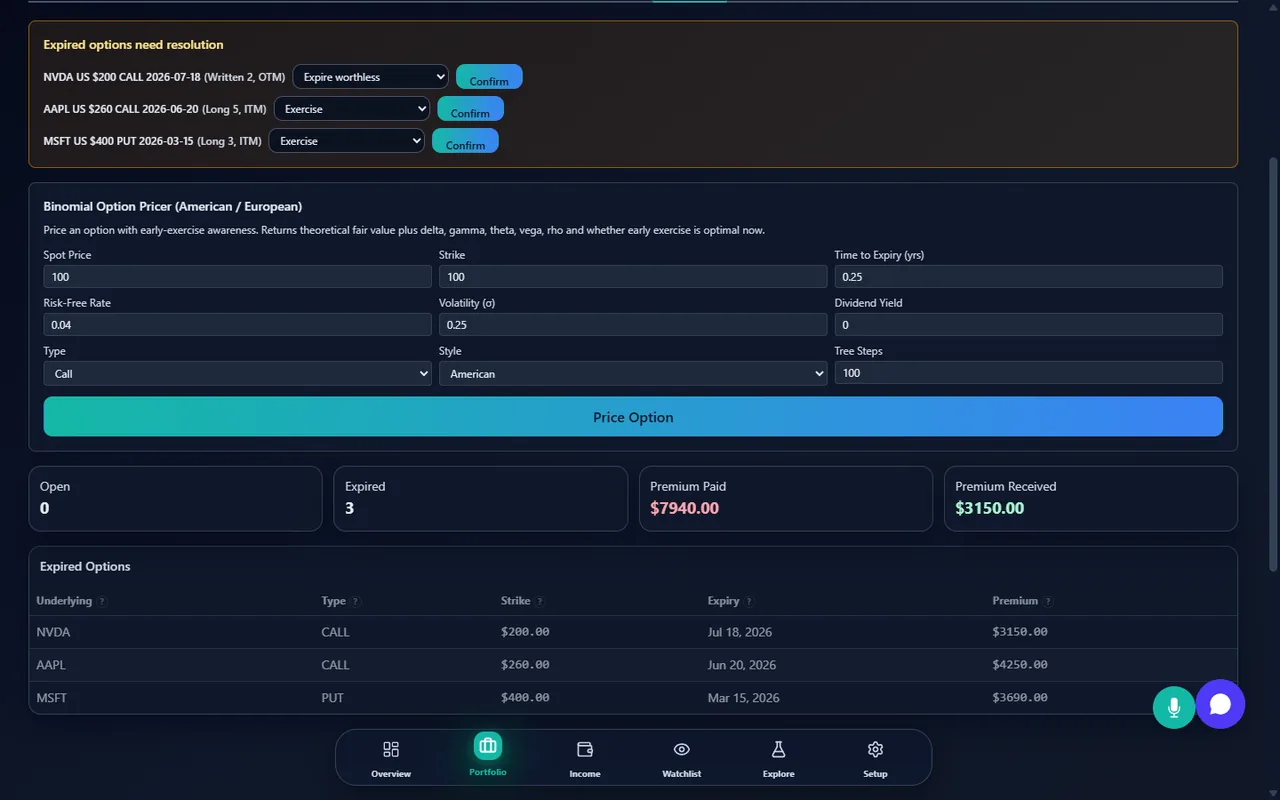
Options Ledger
Record all options transactions — buys, sells, assignments, and expirations — in a unified ledger alongside your stock transactions. Each contract is tracked with its strike price, expiry date, and contract type.
Premium Tracking
Track premiums received from writing options and premiums paid for purchased contracts. See net premium income over time and understand how options activity contributes to your overall portfolio returns.
Expiry & Assignment Tracking
Monitor upcoming expiry dates for your open options positions. When contracts are assigned or exercised, the system records the resulting stock transaction and adjusts your cost basis accordingly.
Options P&L
View estimated profit and loss for each options position, including both open and closed trades. Calculations account for premiums paid or received, commissions, and the current market value of open contracts.
Model-Based Contract Pricing and Greeks
Price any contract with a Black-Scholes or Cox-Ross-Rubinstein binomial model and see intrinsic value, time value, and delta, gamma, theta, vega and rho. Volatility is measured from the underlying security's own price history, and the risk-free rate comes from published central bank data.
Coverage and Risk Classification
Every short contract is classified as covered, cash-secured, part of a defined-risk spread, or naked, by comparing the shares and cash it would require against what you actually hold. Each result carries the shares or cash required, whether margin would be involved, and the bounded maximum loss where one exists.
How it works
Record the opening trade
Enter a contract the way your broker reports it: underlying, market, call or put, strike price, expiry date, number of contracts, and premium per contract. Buying to open and selling to open — writing — are both first-class, and the entry lands on the same ledger as your stock trades.
Positions net by contract, not by symbol
Open positions are grouped by the full contract identity — underlying, market, type, strike and expiry — so two calls on the same stock at different strikes stay separate instead of collapsing into one row. Closing legs net against the opening leg, and a contract that goes flat moves to the closed list.
Review contracts as expiry approaches
The lifecycle view lists every open contract with the outcome your ledger implies: expiring worthless, being assigned, or being exercised. Expiry is measured against the closing bell in the contract's own market rather than your local clock, so a Toronto contract and a Tokyo contract are not both retired at the same moment.
Resolve the contract into real ledger entries
Choosing an outcome writes the resulting legs to the ledger. A worthless expiry closes the contract at zero. Assignment or exercise adds the matching stock leg at the strike price with the premium folded into the per-share cost — and if you are assigned on more shares than you hold, the shortfall is recorded as a short position rather than quietly dropped.
What it does not do
Knowing where a tool stops is worth more than a longer list of what it claims. These are the boundaries of what StockWatcher does here.
There is no live options chain
StockWatcher does not retrieve options chains. Strikes, expiry dates, bid and ask prices, open interest, and implied-volatility surfaces are not pulled from any market data provider. Every contract detail comes from what you enter or import.
Contract values are model output, not market quotes
Open contracts are marked using an option pricing model with volatility measured from the underlying security's own past prices. Those figures are estimates and will differ from the mark your broker shows, particularly for illiquid contracts and around earnings.
No orders, no screening, no strategy suggestions
There is no order routing, no connection to a brokerage, and no screen that ranks strikes by premium or proposes which contract to write. StockWatcher records and analyses trades you have already decided to make.
Legs are recorded individually
A spread is stored as its individual legs. Coverage analysis pairs a long leg against a short leg of the same type and underlying to recognise defined risk, but positions are not saved as a named strategy with a combined profit and loss profile or a set of breakevens.
Related Resources
Start tracking your options positions
Available on the Pro plan. Free 14-day Pro trial included.
Explore plansOptions involve significant risk and are not suitable for all investors. All P&L figures, premium estimates, and strategy analyses are for informational purposes only and do not constitute investment advice. Options trading can result in the loss of your entire investment. Consult a qualified financial advisor before trading options.