Bond & Fixed Income Tracking
Analyze bond and fixed-income holdings with yield to maturity, duration, accrued interest, and clean/dirty pricing — alongside your stocks, ETFs, and other assets.
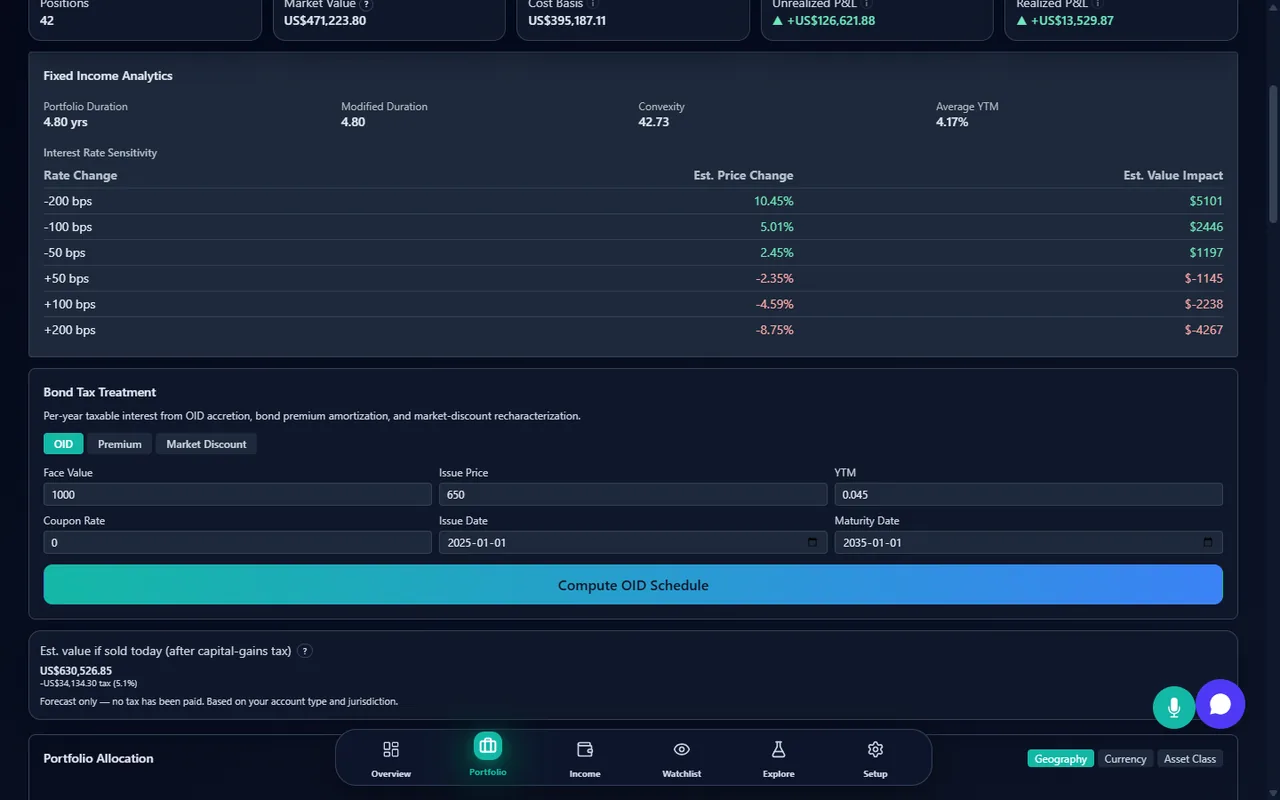
Bond Analytics
Every bond holding is analyzed for yield to maturity, Macaulay and modified duration, DV01, convexity, current yield, and accrued interest — computed directly from face value, coupon rate, price, and maturity date.
Clean & Dirty Price
See both the clean price (excluding accrued interest) and the dirty price (what you actually pay, including accrued interest) for every bond, calculated using 30/360 or actual/actual day-count conventions.
Interest Rate Sensitivity Scenarios
Estimate how a bond's price would move under six standardized rate shifts (±50, ±100, ±200 basis points), using duration and convexity to project the percentage and dollar price impact.
Yield to Worst for Callable Bonds
For bonds with a call schedule, calculate yield to worst — the lower of yield to maturity and every yield to call in the schedule — plus effective duration that accounts for call risk.
Bond Ladder Builder
Build a bond or GIC ladder targeting a specific annual income over a chosen time horizon. Get a per-rung breakdown of principal, yield, and maturity, plus a year-by-year reinvestment plan.
OID, Premium, and Market Discount Tax Schedules
Generate the tax schedules bond holders need: constant-yield OID accretion for discount bonds (IRC §1272), premium amortization (IRC §171), and market discount recharacterization on sale (IRC §§1276-1278).
How it works
Enter the bond the way its term sheet describes it
Face value, coupon rate, coupon frequency, purchase price, settlement date and maturity date, plus a call schedule for callable issues. Those terms are what every figure below is computed from.
Analytics are computed from the terms, not looked up
Yield to maturity, current yield, Macaulay and modified duration, DV01, convexity and accrued interest are all derived from the cash flows the bond's own terms imply, using the day-count convention you select.
See the price two ways, and under moving rates
Clean price excludes accrued interest; dirty price is what actually changes hands on settlement. A standard set of parallel rate shifts shows the estimated price effect of rates moving up or down, using duration and convexity together.
Plan a ladder and keep the tax schedule
Build a bond or GIC ladder targeting an annual income over a chosen horizon, with a per-rung breakdown and a year-by-year reinvestment plan. For discount and premium bonds, the accretion and amortisation schedules that tax reporting asks for are generated alongside.
What it does not do
Knowing where a tool stops is worth more than a longer list of what it claims. These are the boundaries of what StockWatcher does here.
There is no bond price feed
No live quote source exists for individual bonds. Prices come from what you enter. The analytics describe the security you described, and if its market price has moved since, the figures will not know.
Credit quality is not modelled
Issuer ratings, default probability and recovery assumptions are outside what this calculates. A yield to maturity treats every promised coupon as if it arrives; whether the issuer pays is not a question these formulas ask.
Rate scenarios are approximations
Price sensitivity is estimated from duration and convexity under parallel shifts in the yield curve. Real curves twist and steepen rather than moving in parallel, and the approximation degrades as the size of the shift grows.
Tax schedules are reference data, not filings
Original issue discount accretion, premium amortisation and market discount schedules are produced as estimated figures organised the way the rules describe. They are not tax advice and not a substitute for your issuer's or broker's own reporting.
Related Resources
Start tracking your bond and fixed-income holdings
Available on Standard and Pro plans. Free 14-day Pro trial included.
Create Your Free AccountAll yield, duration, and price sensitivity figures are estimates calculated from the bond terms you provide, and do not account for issuer credit risk, call provisions not entered, or market liquidity. OID, premium amortization, and market discount schedules are informational and not a substitute for professional tax advice — consult a qualified tax professional before filing.